The Three M's of Organizational Unity: Motive, Method, Mission
Most organizational problems don’t start with incompetence. They start with misalignment.
You can have smart people. Passionate people. Even well-intentioned people. And still end up with tension, confusion, politics, burnout, and dysfunction.
Why? Because alignment isn’t happening across three critical areas:
Motive.
Method.
Mission.
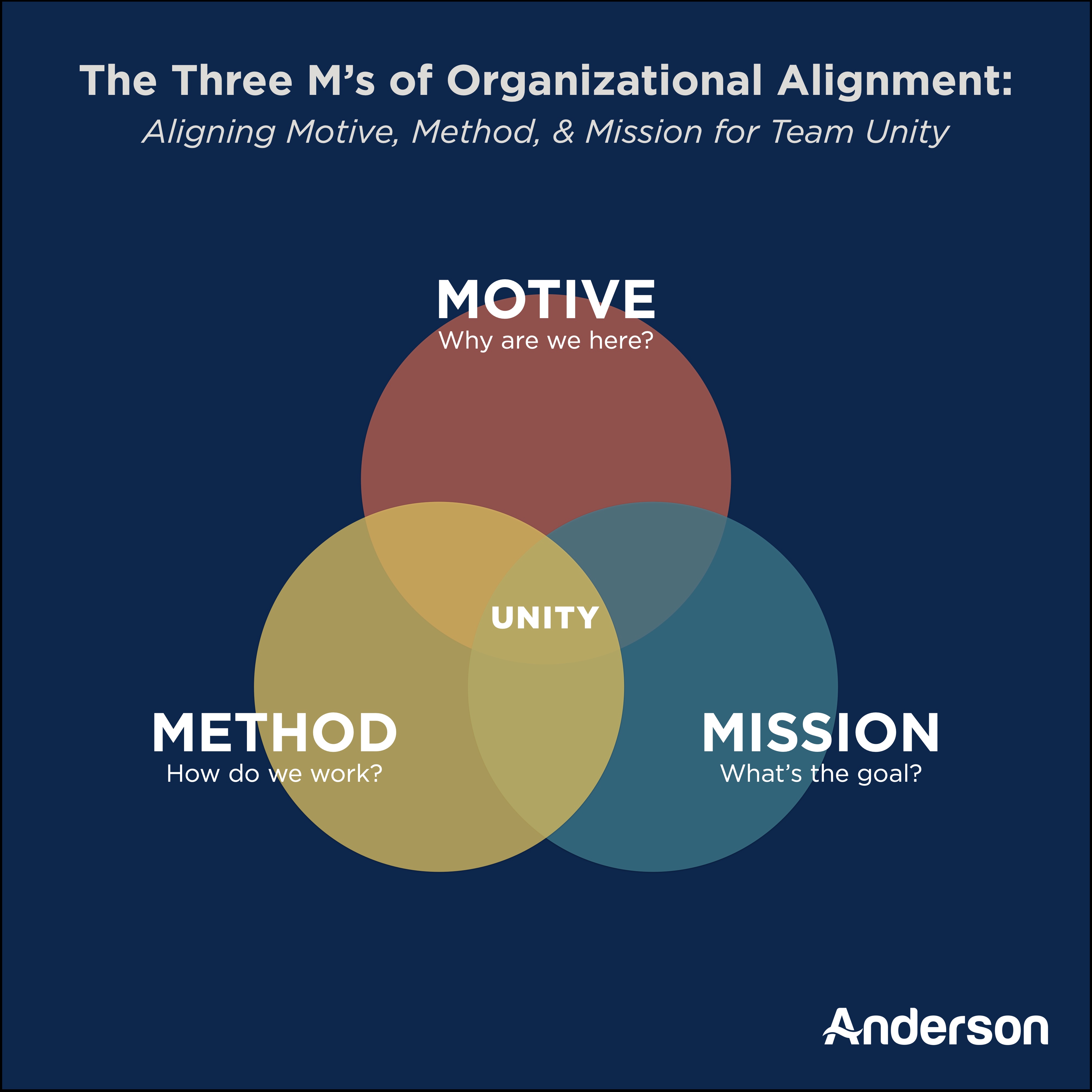
I’ve started thinking of this as the Three Ms of Organizational Unity.
When these three are aligned—or at least honestly acknowledged—you get coherence, trust, and momentum. When even one breaks down, you get chaos.
1. Motive: Why Are You Really Here?
Motive is about why each person is at the table.
And here’s the part that surprises people:
Everyone does not need to have the same motive.
One board member might be there because they deeply believe in the cause. Another might be there because it’s good PR for their business. Another might just genuinely enjoy being part of meaningful work.
That’s not a problem.
The problem arises when there is dishonesty about motive.
I’ve seen nonprofits implode because directors were secretly using funds for personal benefit while publicly presenting themselves as altruistic. That’s not just bad behavior—that’s complete breakdown of alignment. There was deceit about motive, deceit about mission, and the organization paid the price.
Unity doesn’t require identical motives. Unity requires honest motives and mutual acceptance of those motives.
If someone says, “I’m here because this helps my brand,” and everyone agrees that’s acceptable, there’s no betrayal. There’s clarity.
Transparency creates trust. Hidden motives destroy it.
2. Method: How Do We Get the Work Done?
Method is about how each person approaches the work.
People operate differently:
One person leads with data and analytics
Another leads with intuition and experience
Another leads through relationships and networks
Another through systems and process
That diversity is a strength—if it’s understood and respected.
But when people don’t agree on methods, things unravel quickly.
You see this sometimes with athletics.
A team might be completely aligned on motive (“We want to win”) and mission (“We’re going for the championship”), but if they don’t agree on the style of play, work ethic, or strategy, everything falls apart. Players start second-guessing the coach. Coaches lose the locker room. Execution breaks down.
Method doesn’t require everyone to work the same way.
But it does require:
Clear expectations
Honest communication
Mutual respect for different approaches
Alignment in method creates coordination. Misalignment creates friction.
3. Mission: What Are We Actually Aiming At?
Mission is the one area where alignment is non-negotiable.
You can have different motives.
You can have different methods.
But if people are working toward different end goals, the organization will fragment.
This is where chaos really sets in.
One person thinks the nonprofit exists to serve the local community.
Another thinks it exists to grow nationally.
Another thinks it exists to support a specific demographic group.
Now decisions become political. Meetings become frustrating. Progress stalls. People start assuming bad intent where there may not even be any.
Mission requires shared agreement on the ultimate objective.
Not perfect phrasing.
Not identical personal interpretations.
But genuine alignment around the destination.
If the destination isn’t shared, the journey becomes a tug-of-war.
What Happens When One of the Three Breaks?
When motive breaks → Trust collapses
When method breaks → Execution collapses
When mission breaks → Direction collapses
And often, leaders try to fix the symptoms:
“We need better communication.”
“We need more structure.”
“We need to hold people accountable.”
But the real issue is deeper:
There’s misalignment in one of the Three Ms.
The Real Fix Is Often Simple (But Uncomfortable)
Most of the time, this doesn’t require consultants.
It doesn’t require retreats.
It doesn’t require rebranding.
It requires honest conversations.
“Why are you really here?”
“How do you prefer to operate?”
“What do you believe we are actually trying to accomplish?”
Those are vulnerable questions.
But they are also the fastest path to clarity.
A Question for You as a Leader
Look at your organization, your board, your leadership team, or even your family system.
Is there honesty around motives?
Is there clarity and respect around methods?
Is there real agreement around mission?
If not…
Could some of the tension, frustration, or dysfunction you’re experiencing be rooted in misalignment across one of these three areas?
And if so…
Could it be resolved with intentional, transparent conversation?
Because in my experience, unity isn’t built through control.
It’s built through clarity.